The APA — Advance Provisioning Allowance — is the item that most often surprises new charter clients. Many arrive with a budget based on the basic rate displayed in catalogs, only to discover when signing the contract that an additional 25 to 35% must be added for the APA. This is not a hidden surcharge — it is a transparent mechanism that exists for good reasons. But it must be understood before you begin your search.
This guide provides a comprehensive and detailed explanation of APA — what it covers, how it is calculated, what happens at the end of the charter, and how to optimize it according to your itinerary. With real-world examples from our charters on the French Riviera in 2026.
What is APA?
The APA (Advance Provisioning Allowance) is a provision paid at the beginning of a charter to cover all variable expenses on board for the duration of the charter. It is distinct from the basic rate, which only covers the provision of the yacht and its crew.
Operating Principle:
- You pay the estimated APA at the beginning of the charter (generally with the balance of the basic rate, 30 days before departure)
- The captain manages this budget throughout the charter — fuel, port fees, provisions, taxes
- At the end of the charter, the captain provides you with a detailed statement of all expenses with supporting documents
- If the actual total is less than the APA paid: the balance is fully refunded to you
- If the actual total exceeds the APA: you pay the difference
The APA is an expense account administered by the captain on behalf of the client — not a margin for the owner or broker.
What APA Covers — Item by Item
1. Fuel — The Most Variable Item
Fuel is generally the primary APA item — and the most variable depending on the itinerary. A 35-40 meter superyacht consumes between 150 and 500 liters per hour depending on the engine, speed, and navigation conditions.
Factors influencing consumption:
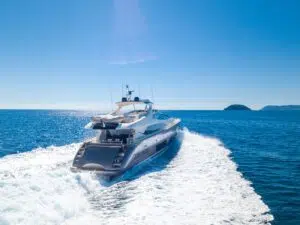
- Cruising speed — navigating at 14 knots instead of 10 knots can triple consumption. Our ASCENSION (Couach 37 m, 20 knots cruising speed) consumes significantly more than a classic superyacht at 12 knots — to be considered in the APA
- Distance traveled — a Monaco-Sardinia-Ibiza itinerary consumes 3 to 5 times more than a stationary week in Cannes Bay
- Generator — during extended anchoring (Cannes Film Festival, Monaco Grand Prix), the generator runs continuously for air conditioning and electronics. Expect 50 to 80 liters/hour
Fuel estimates by usage type:
| Usage | Estimated Consumption | Fuel Cost (€1/L) |
|---|---|---|
| Stationary Charter (Festival, Grand Prix) | 3,000 – 6,000 L | €3,000 – €6,000 |
| French Riviera Cruise (300-400 NM) | 6,000 – 12,000 L | €6,000 – €12,000 |
| Long-distance Cruise (800-1,000 NM) | 15,000 – 30,000 L | €15,000 – €30,000 |
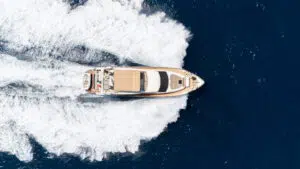
Our RAY (Numarine 32XP, 25,900 L capacity) has a range of 4,000 NM at 12 knots — its unit consumption is optimized for long distances.
2. Port Fees — Variable by Destination
Port fees include mooring at the dock or anchoring rights in regulated areas. They vary considerably depending on the destination and period.
Examples of 2026 rates:
| Destination | Period | Overnight Rate (35-40 m LOA) |
|---|---|---|
| Cannes — standard | May, Sep-Oct | €600 – €1,200 |
| Cannes — Festival | May 13-24 | €1,120 – €2,520 |
| Monaco — standard | Outside events | €1,000 – €2,000 |
| Monaco — Grand Prix | June 4-7 | €2,500 – €6,000 |
| Saint-Tropez — high season | Jul-Aug | €500 – €1,500 |
| Ibiza — high season | Jul-Aug | €400 – €900 |
| Sardinia Porto Cervo | Jul-Aug | €600 – €2,000 |
Practical tip: for superyachts over 35 meters during events in Cannes and Monaco, anchoring in the bay with tender rotations is often more economical than mooring at the dock — savings on port fees can reach 50% over a week.
3. Provisions — According to Your Gastronomic Brief
Provisions cover food, beverages, wines, and spirits for all passengers for the duration of the charter. The amount depends entirely on your gastronomic brief — provided to the onboard chef 3 weeks before departure.
Estimate by profile:
| Profile | Daily Budget per Passenger |
|---|---|
| Standard (simple cuisine, table wines) | €80 – €120 |
| Premium (gastronomy, selected wines) | €150 – €250 |
| Luxury (exceptional products, grand cru wines) | €300 – €500+ |
For a 7-day charter with 10 passengers on a premium standard: 10 × 7 × €200 = €14,000 in provisions.
4. Taxes — Variable by Flag
The VAT applicable to yacht charters varies according to the yacht’s flag and the navigation area. In the European Mediterranean, yachts under a European flag navigating in territorial waters are subject to VAT. Non-EU flagged yachts benefit from a different regime.
Your broker will precisely indicate the applicable tax regime before signing the MYBA contract.
5. Miscellaneous Fees
- Laundry and cleaning (€100 to €300/week)
- Satellite communications (usage-based)
- Pleasure craft tax (depending on navigation areas)
- Entry fees for marine nature parks
- Clearing fees (entry/exit from certain ports)
How to Calculate the Estimated APA
The general rule: APA = 25 to 35% of the basic rate
- For an event charter (Cannes Festival, Monaco Grand Prix) with high port fees: 35%
- For a long-distance cruising charter with high fuel consumption: 30 to 35%
- For a stationary charter at anchor with little navigation: 20 to 25%
Concrete examples with our fleet:
| Yacht | High Season Base Rate | Estimated APA (30%) | Estimated Total |
|---|---|---|---|
| ABELY | €35,000 | €10,500 | €45,500 |
| RAY | €120,000 | €36,000 | €156,000 |
| ASCENSION | €125,000 | €37,500 | €162,500 |
| ANNAMIA | €145,000 | €43,500 | €188,500 |
What APA Does Not Cover
Crew gratuities — not included in the APA. Standard practice is 10 to 15% of the basic rate at the end of the charter for satisfactory service. Gratuities are distributed by the captain to the crew at his discretion.
Shore excursions and activities — restaurants, outings, car rentals, event tickets. These expenses are the client’s responsibility, separate from the APA.
Repairs in case of damage — if equipment is damaged during the charter beyond normal wear and tear, repair costs are not covered by the APA but by the security deposit.
The Security Deposit — Distinct from APA
The security deposit is a separate caution from the APA, generally representing 20% to 50% of the base charter rate. It is refunded at the end of the charter after the yacht’s condition has been verified. Our standard MYBA contract specifies the terms for the return of the deposit.
How to Optimize Your APA
Precise gastronomic brief — the more detailed your brief, the more the onboard chef can optimize orders. Avoid over-provisioning — the unused balance is refunded to you, but perishable goods are lost.
Choose anchoring vs. dock — for events with high pricing pressure (Cannes Festival, Monaco Grand Prix), anchoring in the bay can save €8,000 to €15,000 in port fees over a week.
Adapted cruising speed — for long itineraries, navigating at 12 knots instead of 16 knots can reduce fuel consumption by 40 to 60% depending on the engine.
Stopover planning — our team optimizes the itinerary to minimize port fees by selecting ports and anchorages with the best cost/quality ratio depending on the destination.
MYBA Transparency — Your Guarantee
All our charters are governed by a standard MYBA contract (Mediterranean Yacht Brokers Association) — the international benchmark contract for yacht charter since 1984. This contract requires the captain to keep a detailed account statement of all APA expenses with corresponding supporting documents.
At the end of the charter, you receive this statement with receipts. You can dispute any item that seems unjustified. The unused balance is refunded to you within 10 days of the end of the charter.
This is the most transparent contractual framework in the industry — and the reason why International Yachts Charter and Brokerage works exclusively with MYBA contracts for all its charters on the French Riviera, in Sardinia, the Balearics, and the Caribbean.
Receive a Detailed APA Quote
Our team systematically provides a line-by-line APA estimate in each quote — detailed fuel, port, provisions, and taxes according to your itinerary and preferences. No opaque global figure — a complete breakdown that you can analyze before signing.